

Yamila is 28, Argentinian, and lives in Madrid with her residence and work permit. She works as a sales assistant in an electronics store. One day in mid-May, her supervisor hands her a letter and a pen: “Sign it as agreed, it’s just a formality.” The letter talks about a “serious offense” and a disciplinary sanction. Yamila freezes.
If you have also received a written warning or a disciplinary sanction at work, first things first: a sanction is not a dismissal, and many sanctions have flaws that allow you to challenge them. In this article we go through Yamila’s letter point by point so you know what the law requires from the employer, which sanctions are prohibited, how long the employer has to sanction you, and how and within what deadline you can challenge a disciplinary sanction at work in Spain. If you want your letter reviewed before the deadline runs out, message Fernanda Vargas on WhatsApp or book an appointment on her Calendly.
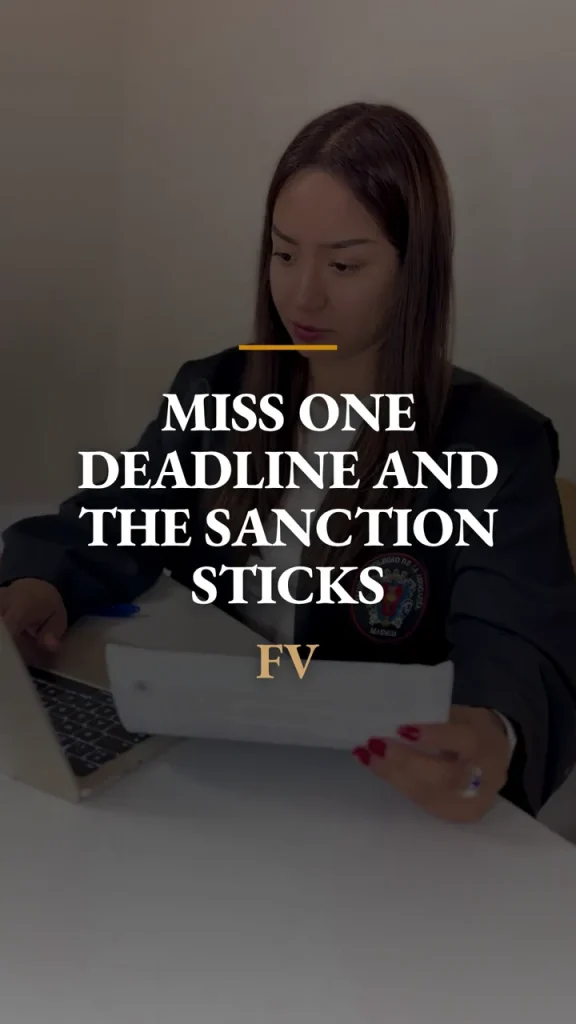
Read the transcript
Sanctioned at work in Spain? Miss one deadline and it can count against you.
You have 20 working days from notification to challenge it.
Don't sign "as agreed". Sign only "received", with the date.
Your employer has 10, 20 or 60 days to sanction you, from when it found out.
If it waits longer, the offense is time-barred.
And it can never take your vacation days or dock your pay as punishment.
A serious offense must reach you in writing, with the dates and the facts.
Happened to you in Spain? Message me on WhatsApp and I'll look at it.
“Serious Offense for Lateness”: the Letter Yamila Receives
Let’s start with what happened. In March, Yamila’s metro line was under construction. That month she arrived late three times, about twenty minutes each time. All three delays were recorded in the store’s time-tracking system, and her supervisor mentioned it to her at the time, every time.
Weeks go by and nobody brings it up again. Until, in mid-May, about 45 days after the last delay, the letter arrives. It reads:
“Serious offense for repeated lateness; sanction of five days’ suspension of employment and pay and loss of two days of vacation.”
That’s all. The letter does not say on which dates she was late or by how much. And the company asks her to sign it “as agreed.”
Yamila is scared. She doesn’t know whether she should sign or what happens if she does. The good news is that she does not have to sign “as agreed”: she can sign only “received” with the date, and that does not mean accepting the facts or the sanction. Even if she signs for receipt, she can still challenge it. Let’s go through it with her letter in hand. (The details of the case are illustrative.)
What the Law Says About Sanctions: Collective Agreement, Form and Court Review
Employers can sanction their employees, but not however they like. The basic rules are in Article 58 of the Workers’ Statute (Estatuto de los Trabajadores), and they come down to three ideas.
1. Only What Is Provided For Can Be Sanctioned: Classification of Offenses
The employer can only sanction conduct that is defined as an offense, and only with the sanctions provided for that offense, in the law or in the collective agreement (convenio colectivo) that applies to your job. This is called classification (tipificación): the conduct must be described in advance as an offense (minor, serious or very serious) and have a specific sanction assigned to it.
In practice, collective agreements usually have a chapter on “offenses and sanctions” or “disciplinary rules.” That chapter says what counts as a minor offense, what is serious and what is very serious, and which sanction applies to each. That is why, when you receive a sanction, the first step is to find your collective agreement and read that chapter.
2. Serious and Very Serious Offenses: in Writing, With the Date and the Facts
Article 58.2 requires that sanctions for serious and very serious offenses be communicated to the employee in writing, stating the date and the facts behind them. A generic label such as “repeated lateness” is not enough: you need to be able to know what you are being accused of and when it happened, so you can defend yourself.
In addition, many collective agreements add their own requirements, for example giving the workers’ representatives a hearing in certain cases. If your agreement provides for them, the employer must also comply with them.
3. You Can Always Take It to Court
The same Article 58.2 says that the assessment of offenses and the sanctions imposed by the employer can always be reviewed by the labor courts, that is, by the Labor Court (Juzgado de lo Social). The employer’s decision is not the final word: a judge can review whether the facts are true, whether they are correctly classified and whether the sanction is the right one.
Watch out for a common confusion: a sanction is not a dismissal. A sanction is a penalty within an employment relationship that continues (a written warning, a suspension of employment and pay for a few days). Disciplinary dismissal ends the contract and has its own rules, which we explain in our guide to disciplinary dismissal in Spain, the prior hearing and its deadlines.
Sanctions You Can Never Be Given: Vacation, Rest and Fines
Back to Yamila’s letter. Besides five days’ suspension of employment and pay, the company takes away two days of vacation. Here there is no need to check the collective agreement: that part of the sanction is prohibited by law, whatever any other document says.
“Sanctions consisting of a reduction in the length of vacation or any other reduction of the employee’s rights to rest, or a fine on wages, may not be imposed.”
Article 58.3 of the Workers’ Statute
Put simply, there are two types of sanction the employer can never impose:
- Taking away vacation or rest. They cannot punish you with fewer vacation days, or by taking away days off or rest periods you are entitled to.
- A fine on wages (multa de haber). This is an old-fashioned term meaning deducting money from your pay as a punishment while you keep working. For example, “this month we are docking your pay for arriving late.” It is prohibited.
What about suspension of employment and pay? That is a permitted sanction, as long as the collective agreement provides for it for that offense. The difference from a fine on wages is that during the suspension you do not work, and that is why you are not paid for those days. What is prohibited is making you work and taking money away as a punishment.
In Yamila’s case, the two vacation days taken away are a sanction that is prohibited in every case. This is the first problem with her letter.
The Limitation Period: How Long the Employer Has to Sanction You
Now comes the most important part of Yamila’s case. The employer cannot keep an offense in a drawer and sanction it whenever it suits them. The law gives them a deadline, and if they let it pass, the offense becomes time-barred (prescripción): it can no longer be sanctioned simply because time has passed.
“With regard to employees, minor offenses shall be time-barred after ten days; serious offenses, after twenty days; and very serious offenses, after sixty days from the date on which the company became aware of their commission and, in any event, six months after they were committed.”
Article 60.2 of the Workers’ Statute
This means there are two deadlines running at the same time:
| Type of offense | Deadline from when the employer becomes aware | Maximum deadline from when it was committed |
|---|---|---|
| Minor | 10 days | 6 months |
| Serious | 20 days | 6 months |
| Very serious | 60 days | 6 months |
- The short deadline (10, 20 or 60 days) starts running when the employer finds out about the offense.
- The long deadline (6 months) runs from when the events happened, even if the employer did not find out. After six months, the offense can no longer be sanctioned in any case.
When the offense consists of several repeated acts (such as several late arrivals), the courts count the deadline from the last one.
Doing the Math for Yamila
The company classifies the late arrivals as a serious offense, so it had 20 days to sanction. From when? From when it became aware of the late arrivals. And here there is no doubt: all three were recorded in the time-tracking system and the supervisor mentioned them to Yamila at the time. The company knew in March.
Even counting from the last late arrival, the letter comes about 45 days later. More than twice the 20 days the law allows for a serious offense. That is why the offense is probably time-barred. This is the third problem with the letter, and the most important one: if the offense is time-barred, the company could no longer sanction it.
And the second problem? We saw it earlier: the letter does not state the dates of the late arrivals, and Article 58.2 requires the written notice to state the date and the facts.
Is What Yamila Did Serious? Check the Collective Agreement
The company says that three twenty-minute late arrivals are a serious offense. Are they? The answer is not in the Workers’ Statute, but in the collective agreement that applies to Yamila’s store.
Each collective agreement decides which conduct is minor, serious or very serious, and each does it differently. That is why you cannot say in general that being late a certain number of times is always a serious offense, or always a minor one. You need to read the chapter on offenses and sanctions and check three things:
- How the agreement classifies the specific conduct (in this case, the late arrivals: how many, how long and over what period).
- Which sanctions it provides for that type of offense, and whether the one you were given is among them.
- Whether it requires any additional step before a sanction is imposed.
This matters a lot, including for the limitation period. If Yamila’s agreement treated those late arrivals as a minor offense, the deadline to sanction would be even shorter (10 days), and suspension might not be the sanction provided for a minor offense. Either way, the classification as serious has to be checked, not taken for granted.
One more note: if the sanction relies on footage from the company’s cameras, there are legal limits on how it can be used. We cover them in our article on workplace video surveillance in Spain and its legal limits.
How to Challenge a Disciplinary Sanction at Work and the Deadline
If you disagree with the sanction, you can challenge it, that is, ask a judge to review it. Here the clock is running against you, and the deadline is short.
The Deadline: 20 Working Days
The Labor Jurisdiction Act (Ley reguladora de la jurisdicción social) sets a deadline of 20 working days from when you are notified of the sanction to challenge it before the Labor Court. Working days means that not every calendar day counts, but the deadline goes by very quickly. If you let it pass, the sanction becomes final.
First, the Conciliation Request
Normally, before going to court you have to file a conciliation request (papeleta de conciliación): a document in which you explain that you disagree with the sanction and ask for it to be canceled. The employer is summoned to a conciliation hearing, where the parties try to reach an agreement. If there is no agreement, the claim is filed with the Labor Court.
What the Judge Can Decide
The judge can do three things with the sanction:
- Uphold it, if the judge finds that the offense occurred, is correctly classified and the sanction is the right one.
- Reduce it to a lesser sanction, if the offense occurred but was less serious than the employer said.
- Cancel it, for example if the offense did not occur or can no longer be sanctioned.
No trial has a guaranteed outcome. It depends on the evidence, the collective agreement and how the facts are assessed. That is why it is a good idea for Fernanda Vargas to review your case before you decide.
Why It Is Worth Not Letting It Go
Many people think: “It’s only five days, better not to make a fuss.” But a sanction you do not challenge becomes final, and a final sanction can be taken into account in the future, for example to assess repeat offenses if the employer ever moves toward a disciplinary dismissal. Building up final sanctions can count against you.
If you have been sanctioned and don’t know whether your case has a defense, Fernanda Vargas, employment lawyer in Madrid, can review the letter, your collective agreement and the dates before the deadline runs out. You can see how she works on her employment law page.
Signing “Received” Is Not Accepting
Let’s go back to the moment the supervisor hands Yamila the letter and asks her to sign it “as agreed.” What should she do?
Yamila does not have to sign “as agreed.” What she can do is sign that she has received it: write “received” and the date, and sign below. Signing for receipt does not mean accepting the facts or the sanction. It only records that the letter was given to you and when, which is also useful for counting your own deadline.
After signing, it is a good idea to do the following:
- Keep a copy of the letter (or take a photo of it) with your signature and the date.
- Write down the key dates: when the events happened, when the employer found out and when you were given the letter.
- Gather evidence: time-tracking records, messages, supporting documents (for example, notices of public transport disruptions) and the names of coworkers who could testify as witnesses.
- Find your collective agreement and read the chapter on offenses and sanctions.
- Act within the deadline of 20 working days, starting with the conciliation request.
How Yamila’s Story Ends
With the letter reviewed point by point, Yamila’s sanction has several problems. First, taking away two days of vacation is prohibited in every case. Second, the letter does not state the dates of the events, as the law requires for a serious offense. Third, and most important, the offense is probably time-barred: the company knew about the late arrivals since March and imposed the sanction about 45 days later, when the deadline for a serious offense is 20 days. In addition, it would have to be checked whether her collective agreement really classifies those three late arrivals as a serious offense.
Yamila signs “received” with the date, keeps a copy and gathers her time-tracking records. With that, she can challenge the sanction within the 20 working days, starting with the conciliation request.
Five Questions to Review Any Sanction
If you have been sanctioned, ask yourself these five questions with the letter in front of you:
- Is it provided for? Does your collective agreement (or the law) list that conduct as an offense, with that level of seriousness and with that sanction?
- Is it in the correct form? If it is a serious or very serious offense, were you notified in writing with the date and the facts? Does your agreement require any other step?
- Is it a prohibited sanction? Are they taking away vacation, days off or rest periods, or deducting money from your pay as a punishment?
- Is it time-barred? Have more than 10, 20 or 60 days (depending on seriousness) passed since the employer became aware of the facts, or more than 6 months since they happened?
- Am I still in time? Have fewer than 20 working days passed since you were notified of the sanction?
If any answer makes you hesitate, don’t leave it for tomorrow: the deadline runs from the day you received the letter.
Frequently Asked Questions
Can I Challenge a Suspension of Employment and Pay?
Yes. Every sanction imposed by the employer can be reviewed by the Labor Court, including suspension of employment and pay. Suspension is a permitted sanction if your collective agreement provides for it for that offense, but you can dispute whether the facts are true, whether they are correctly classified, whether the offense is time-barred or whether the letter meets the formal requirements. The deadline is 20 working days from notification, and normally you must file the conciliation request first.
Can They Take Away Vacation Days as a Punishment?
No. Article 58.3 of the Workers’ Statute prohibits sanctions that reduce the length of vacation or any other right to rest. Nor can they punish you by deducting money from your pay while you keep working (the so-called fine on wages).
How Long Does the Employer Have to Sanction Me?
It depends on how serious the offense is. Minor offenses are time-barred after 10 days, serious ones after 20 days and very serious ones after 60 days, counted from when the employer became aware of them. And in any event, they are time-barred six months after they were committed, even if the employer never found out. What counts as minor, serious or very serious is set by the law or, above all, by the collective agreement that applies to you.
Do I Have to Sign the Sanction Letter?
You do not have to sign that you “agree.” You can sign only “received” with the date: that records that the letter was given to you, but it does not mean you accept the facts or the sanction. Always keep a copy.
How Long Do I Have to Challenge It?
20 working days from when you are notified of the sanction, under the Labor Jurisdiction Act. Normally you have to start by filing the conciliation request. If the deadline passes without you doing anything, the sanction becomes final and can be taken into account later, for example in a disciplinary dismissal.
Have you received a sanction and want to know whether it can be challenged? Message Fernanda Vargas, employment lawyer in Madrid, on WhatsApp or book an appointment on her Calendly, and have your case reviewed before the deadline runs out.