
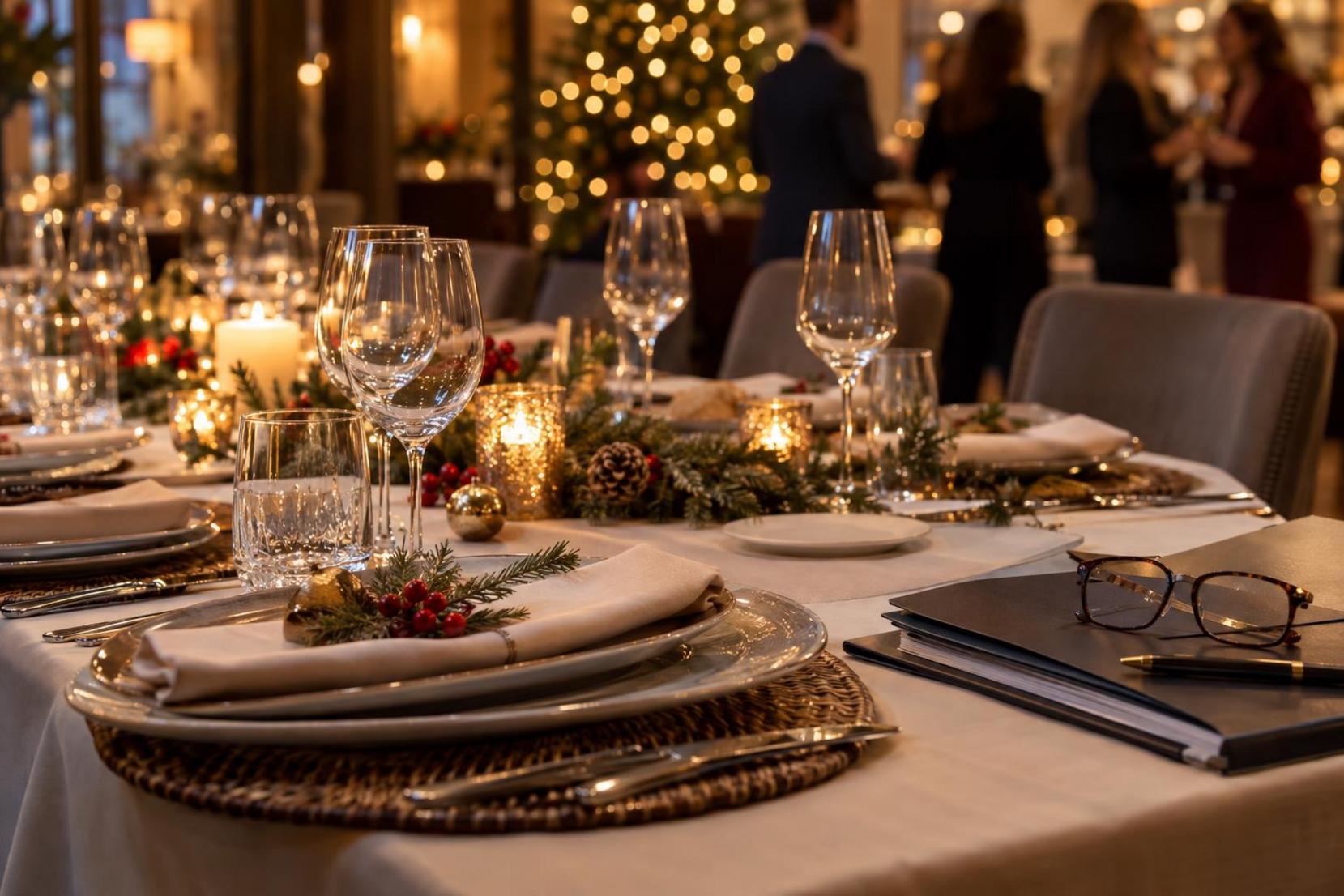
If you have questions about a company dinner or lunch, an accident, a dismissal, or an employment claim, you can contact Fernanda Vargas, employment lawyer in Madrid, via WhatsApp or book an appointment on Calendly.
Introduction: why the company dinner also has legal consequences
The company dinner is often presented as a relaxed occasion, but that does not mean it falls outside labor law. In Spain, there is no specific rule devoted to company dinners or lunches. Their legal framework is built from the General Social Security Act (Ley General de la Seguridad Social), the Workers’ Statute (Estatuto de los Trabajadores), ILO Convention 190, equality and harassment regulations, data protection, and, above all, case law.
That is why the same social label — “Christmas dinner” or “company lunch” — can lead to very different consequences. A voluntary gathering among coworkers is not the same as a dinner that is part of a business trip, with professional content, or an event with mandatory attendance and a schedule adapted to shifts.
Very important issues depend on that difference: whether an injury can be classified as a workplace accident, whether the return journey is covered, whether conduct outside working hours can justify a dismissal, whether the company’s harassment protocol must be activated, or whether photos may be shared without permission.
The key idea is this: in company dinners, there are no automatic answers. The courts look at the specific case and usually assess whether attendance was mandatory, who organized and paid for the event, whether the event had real work-related content, and the connection between what happened and the work.
Is it mandatory to go to the Christmas dinner? Voluntariness, working time, and collective bargaining agreement
In practice, many Christmas dinners are presented as voluntary social activities. When the company presents them that way, the voluntary nature weighs in favor of understanding that we are outside ordinary working time and place. In that scenario, non-attendance is less likely to amount to a breach of employment obligations.
That said, it is not enough for the event to be called a “company dinner.” What matters is how it is actually configured. Case law has recognized workplace accidents at dinners with mandatory attendance or with clear professional content. That is why it is worth reviewing not only the invitation, but also the collective bargaining agreement (convenio colectivo), the internal policy, and the way the company organizes the event.
To determine whether a dinner is truly voluntary or whether it is closer to a work activity, these indicators usually matter:
- whether attendance is imposed or clearly expected;
- whether the schedule is adapted to shifts or production needs;
- whether the event is held on the company’s premises;
- whether incidents, targets, or work planning are discussed during the dinner;
- whether it is part of a business trip or a work assignment.
Payment by the company is a relevant factor, but by itself it does not resolve the issue. There may be an activity paid for by the company that remains purely recreational and voluntary, and there may be a dinner whose work connection is strong because of its content, even if it takes place in a restaurant or outside normal working hours.
Is what happens at the dinner a workplace accident? Article 156 LGSS and relevant occasionality
The starting point is Article 156 of the General Social Security Act. The law considers a workplace accident to be any bodily injury suffered by the employee on the occasion of or as a consequence of work. It also expressly includes in itinere accidents and tasks other than the usual ones when they are carried out by order of the company or in the interest of its proper functioning.
The same rule presumes that injuries occurring at the time and place of work are work-related, unless proven otherwise. But that presumption does not apply outside that framework. At a company dinner or lunch, we are often precisely outside ordinary working time and place, so whoever asserts the work-related nature of the accident will have to prove the connection with work.
That is where the Supreme Court’s doctrine of “relevant occasionality” comes in. According to that doctrine, it may be enough that work was the condition without which the accident would not have occurred. That idea makes it possible to find a workplace accident even outside strictly productive activity, provided there is a real link with work and not a merely environmental or social coincidence.
Applied to company dinners, this means that not every accident at a Christmas event is work-related, but neither is it excluded simply because it is held in a restaurant or outside ordinary working hours. What is decisive is the intensity of the relationship with work.
When the courts have recognized it: mandatory attendance, business dinners, and business trips (High Court of Justice of Navarre 191/2026, High Court of Justice of Catalonia 2024)
The most striking judgment in this area is that of the High Court of Justice of Navarre 191/2026. The court confirmed as a workplace accident, on a business trip, the subarachnoid hemorrhage suffered by a director during a dinner with the Bulgarian company on a trip to Sofia. The decisive fact was that incidents from the day were being analyzed at that dinner and the following day’s work was being planned. It was therefore not a simple courtesy meal, but a functional extension of the business trip. The ruling dismissed the appeal by Mutua Fraternidad and declared it liable for the benefits, including total permanent incapacity.
The High Court of Justice of Catalonia also found, in a judgment of July 17, 2024, that a cardiovascular death occurring at a Christmas dinner held on the company’s premises was a workplace accident. Two factors carried particular weight: mandatory attendance and a schedule adjusted to work shifts.
Case law offers other examples in the same direction. The High Court of Justice of Andalusia, in 2021, classified as work-related the heart attack suffered after a kart race organized and paid for by the company as a prize. And the High Court of Justice of Madrid, also in 2021, considered work-related the death of an engineer in a hotel after dining with his boss during a trip connected to a tender process.
These cases show a fairly clear pattern: recognition usually comes when the event is integrated into the company’s operations, when the employee’s presence is not truly free, or when the activity is part of professional travel, a work assignment, or an especially strong employment connection with what occurred.
When not: voluntary recreational activities and common illness
The other side of the coin is just as important. The courts have rejected work-related classification when there is not a sufficient link with work.
That happened in the High Court of Justice of Madrid, in a judgment of May 8, 2023, which considered anxiety attributed to a conflict arising at the Christmas lunch to be a common illness because there was not enough evidence of the work-related nature of the condition. It was not enough simply to place the origin of the distress in that context.
The High Court of Justice of Galicia, in 2020, denied occupational classification in a paintball activity organized by coworkers, without any order or payment by the company. And the High Court of Justice of Catalonia, in 2017, did the same with a voluntary Segway outing on a non-working Saturday that was open to family members.
Even on business trips there are limits. In 2017, the Supreme Court held that a death occurring in a hotel room before the start of the workday was a common contingency. Being away for work does not automatically turn everything that happens into a workplace accident.
In practical terms, these factors usually move away from work-related classification:
- a purely recreational activity;
- clearly voluntary attendance;
- organization outside the company or without its real involvement;
- being open to family members or a broader social circle;
- absence of professional content;
- lack of evidence of the link between the injury and the work.
That is why, when the event is strictly social, the accident or subsequent illness is not automatically covered as an occupational contingency.
The journey home: an in itinere accident after the company dinner?
The law expressly includes in itinere accidents, but on the way back from a company dinner the protection is not automatic. First, it is necessary to determine whether the event itself can be legally connected to work. Then, whether the return journey maintains a direct and normal link with that event.
As of today, there is no direct Supreme Court judgment on the return from a company dinner as such. The guideline emerging from case law is that the protection will depend on two questions: whether the dinner counts as work for these purposes and whether the return was direct, without essential changes that break the link.
In a judgment of January 12, 2022, the High Court of Justice of the Valencian Community denied protection to a kitchen assistant who voluntarily stayed with coworkers until 4:45 a.m. The court held that this behavior broke the necessary link for speaking of an in itinere accident.
By contrast, in a judgment of January 27, 2025, the High Court of Justice of Castile and León did protect a journey in which there had been no essential alteration. The difference, once again, lay in the facts: continuity of the journey and absence of a significant break in the route or in the reasonable time for returning.
If the accident occurs when returning from a company dinner, it is advisable to analyze in detail whether the event was mandatory, its content, the departure time, whether there were voluntary extensions, and whether the route was the normal one. In this area, nuances matter a great deal.
Conduct that can cost you your job: assaults, insults, and harassment (Supreme Court 494/2022 and Article 54 of the Workers’ Statute)
The fact that the dinner takes place outside the workplace and outside working hours does not mean that anything goes. Article 54 of the Workers’ Statute allows disciplinary dismissal, among other cases, for verbal or physical offenses against coworkers and for harassment on grounds of racial or ethnic origin, sex, and other protected grounds.
The key ruling is Supreme Court 494/2022, of May 31. The Supreme Court upheld the dismissal of an employee who, at a Christmas lunch paid for by the company, insulted coworkers with racist expressions and tried to assault them with a bottle. The High Court of Justice of Madrid had previously held that the dismissal was unfair because the events had occurred outside the workplace and outside working hours. The Supreme Court corrected that approach and gave weight to the impact on workplace coexistence and the dignity of employees, also linking it to Article 10 of the Constitution.
The practical lesson is clear: if the conduct has effects on the employment relationship, workplace coexistence, or the dignity of coworkers, the fact that it occurs at a Christmas dinner does not neutralize the company’s disciplinary power.
Not every argument will give rise to dismissal, because it will always be necessary to assess the specific seriousness of what occurred. But assaults, serious insults, discriminatory expressions, and harassing conduct are the area of greatest disciplinary risk.
Harassment at the dinner: ILO Convention 190 and the company’s protocol also apply
Social activities related to work are not a rule-free zone. ILO Convention 190, in force in Spain since May 25, 2023, includes within its scope violence and harassment occurring during travel, trips, events, or social or training activities related to work.
That means a company dinner or lunch can fully trigger the employer’s obligations of prevention and response against harassment. It does not matter if it is in the evening, in a restaurant, or in a festive setting. If the event is related to work, the protection still operates.
In addition, companies must have a protocol against sexual harassment and harassment on grounds of sex, in accordance with Article 48 of Organic Law 3/2007, reinforced by Organic Law 10/2022. At a company dinner, that protocol is not suspended: it must be capable of being activated if unacceptable conduct occurs.
For employees, this has an important practical consequence: a harassment situation suffered at the dinner should not be treated as a simple personal issue or “something outside work.” It can and should be channeled through the appropriate internal and legal routes, and it is advisable to seek advice as soon as possible.
Photos and videos on social media: consent, data protection, and what the AEPD says
Group photos and impromptu videos are common at this time of year, but uploading images of other people to social media is not a legally neutral gesture. The Spanish Data Protection Agency (AEPD) has reminded people that, before publishing images of others, they must make sure those people agree.
This applies both to coworkers and to company managers. A festive atmosphere does not remove the duty to respect the image and personal data of those who appear in the posts.
If an image has already been published and the affected person asks for it to be removed, there are specific steps they can take. If it is not deleted, they can request removal from the social media platform itself. And if the platform does not respond within 10 days or the response is not adequate, they can file a complaint with the AEPD enclosing the prior request.
The AEPD has also recalled sanctioning examples. One of them ended with a fine of 9,000 euros for publishing photographs of a third party without a legal basis: 5,000 euros for infringement of Article 6 of the GDPR and 4,000 euros for infringement of Article 13.
The most prudent recommendation is simple: before sharing photos or videos from the dinner, ask. If someone does not want to appear or does not want the content to be published, it is advisable to respect that immediately.
Alcohol, schedules, and the following day: absences, lateness, and sick leave
The fact that the company organizes or pays for a dinner does not automatically make absences or lateness the following day justified. If the employee has a shift or workday the next day, the ordinary rules on attendance, punctuality, and justification still apply.
Nor will every medical leave after the dinner be occupational in nature. As the courts show, the classification will depend on the link with work and the evidence available. There may be cases of workplace accidents, but also cases that end up being considered a common contingency.
From a preventive point of view, companies and employees should take three ideas seriously: the dinner does not suspend basic employment obligations, alcohol consumption does not excuse serious conduct, and later health problems require careful analysis of the cause and context.
Checklist for companies and HR before organizing the dinner
- Define from the outset whether attendance is voluntary or whether there is any company expectation of attendance.
- Avoid ambiguous messages: if it is voluntary, it is advisable to communicate that clearly.
- Review whether the collective bargaining agreement or internal policy contains relevant provisions on social events, working time, or travel.
- Assess whether the event will have real professional content. If work matters are going to be discussed, it is advisable to be aware that this may strengthen its work connection.
- If it is held as part of a trip or assignment, be especially clear in the organization, because the risk of classification as a workplace accident increases.
- Before the event, remind everyone of the rules on respect, coexistence, and non-discrimination.
- Check that the protocol against sexual harassment and harassment on grounds of sex is also operational for social events related to work.
- Designate a clear channel for reporting incidents occurring during the dinner or immediately afterward.
- Give prudent instructions on photos and videos, avoiding publications without the agreement of the affected persons.
- Document the organization of the event well, because in a later dispute the details matter a great deal.
Checklist for employees and frequently asked questions
For employees, a few precautions can avoid many legal and personal problems.
- Read the announcement and check whether attendance is truly voluntary.
- If the event is part of a trip or work activity, keep the relevant information about time, place, and content.
- If a health or safety incident occurs, try to leave a record of what was happening and in what context.
- Avoid extensions or detours that may break the link in the return journey if a problem later arises.
- Do not normalize insults, assaults, or harassing conduct just because it is a party.
- Do not publish photos or videos of coworkers without first making sure they agree.
- If you suffer a serious problem at the dinner or afterward, seek advice as soon as possible.
Can they force me to go to the company dinner?
It depends on how the event is set up. If the dinner is presented as a voluntary social activity, its voluntary nature weighs in favor of understanding that it is not part of ordinary working time. If, by contrast, the company requires attendance or integrates the dinner into work organization, the analysis changes and it is advisable to review the specific case, the collective bargaining agreement, and the company’s communications.
If I am injured at the dinner, is it always a workplace accident?
No. It will only be so if there is a sufficient connection with work. The courts have recognized workplace accidents at mandatory dinners, at events with professional content, and on business trips. By contrast, when they are voluntary recreational activities or the link is not properly proven, the contingency may be considered common.
What if the accident happens on the way back home?
It may be protected as an in itinere accident, but not automatically. Normally, it will be necessary to prove that the dinner was connected to work and that the return was direct, without an essential alteration of the journey or a voluntary extension that broke the link.
Can I be dismissed for what I do at the dinner even if it is outside working hours?
Yes, if the conduct seriously affects workplace coexistence, the dignity of coworkers, or falls within the disciplinary grounds of Article 54 of the Workers’ Statute. The Supreme Court has already upheld dismissal for racist insults and attempted assault at a Christmas lunch paid for by the company. It is not enough to say it happened “outside work” if its effects impact the employment relationship.
Does the company’s harassment protocol also apply to the dinner?
Yes, when it is an event or social activity related to work. ILO Convention 190 expressly includes that type of situation within its scope, and the company must be able to activate its protocol against sexual harassment and harassment on grounds of sex in that context as well.
Can they upload photos of me to social media without asking me?
An image of another person should not be published without first making sure they agree. If it has already been published and it is not removed after being requested, removal can be requested from the social media platform and, if it does not respond within 10 days or the response is not adequate, a complaint can be filed with the AEPD enclosing the prior request.
Conclusion and legal notice
The company dinner of 2026 may seem like a simple end-of-year tradition, but legally it is not always harmless. An accident, a dismissal, a harassment situation, or the dissemination of images can open real disputes. Since there is no single rule for all dinners, each case requires careful study of whether the event was mandatory, its content, the company’s organization, and the available evidence.
This article provides general information and does not replace the individualized analysis of a specific case. If you need to review a workplace accident, a disciplinary dismissal, a company protocol, or a claim related to a company dinner or lunch, you can request employment law advice with Fernanda Vargas. You can also write to her on WhatsApp or book an appointment on Calendly.