
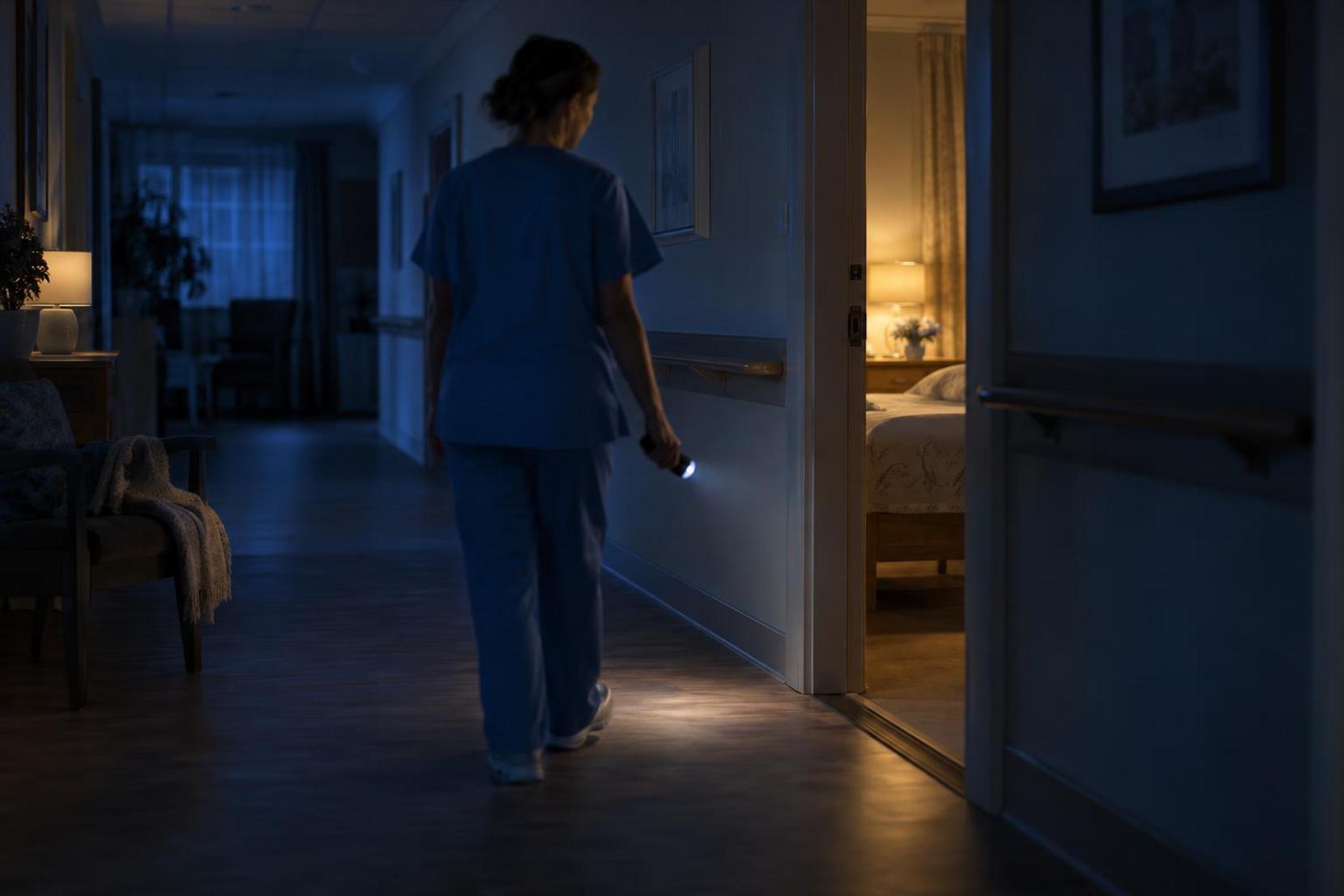
Working nights wears you down. You sleep while everyone else is awake, you eat at odd hours and you see less of your family. That is why night work in Spain has special protection under the Workers’ Statute (Estatuto de los Trabajadores): limits on working hours, a ban on overtime, a night work bonus and a free health assessment. In this article we explain it through the case of Fátima, who has worked the night shift at a care home for two years.
If, as you read, you see that your employer is not complying, you can write to Fernanda Vargas, employment lawyer in Madrid, on WhatsApp or book an appointment on Calendly to review your case.
Four Nights a Week: Fátima’s Situation
Fátima is 37, Moroccan, and holds a long-term residence permit. She works as a care assistant (gerocultora) at a private care home for older people in Zaragoza. A care assistant is the person who looks after the residents directly: she helps them wash, move around, and keeps them company when they wake up in the early hours.
For the past two years Fátima has had a fixed night shift: she starts at 22:00 and finishes at 8:00, four nights a week. And over these two years, several things have piled up that do not add up for her:
- She stays longer. When someone from the morning shift is missing, the manager asks her to stay until 10:00 and pays her those two hours separately, “as overtime”.
- There is no bonus on her payslip. She has checked her payslips and there is no night work item anywhere.
- She has never had a medical check-up. Not when she started on the night shift, and not since.
- Her health is suffering. Lately she sleeps very badly and has digestive problems.
She has seen that there is a vacancy on the morning shift and would like to apply for it, but she is afraid it will be refused or that the manager will take it badly. Let’s look at her situation with the law in hand. Fátima’s hours are an example to explain the rules, but if you work nights, they will probably sound familiar.
What Night Work Is and Who Is a Night Worker
The first step is to find out whether these rules apply to Fátima. To do that, you need to tell apart two ideas that look very similar but are not the same: night work and the night worker.
Night Work: the Hours Between 22:00 and 6:00
Article 36.1 of the Workers’ Statute sets the time window:
“For the purposes of this law, night work is considered to be work carried out between ten at night and six in the morning.”
Put simply: any hour you work between 22:00 and 6:00 is night work. It does not matter what your shift is called or what your contract says. If you start at 23:00 or finish at 2:00, the hours inside that window are night hours. These are the hours that can give you the right to specific pay, the night work bonus (plus de nocturnidad), which we cover further down.
The Night Worker: Someone Who Regularly Works Nights
Working the odd hour at night does not automatically make you a night worker. The law considers a night worker to be someone who regularly works at night, and it sets two criteria. Meeting one of them is enough:
- Normally working at least three hours of their daily working day between 22:00 and 6:00.
- Or being expected to work at least one third of their annual working time in that window.
The difference matters a lot. Night work hours can give you the right to the bonus. But only a night worker also has the limits on working hours, the ban on overtime and the health protection we explain below.
And Fátima? Her shift runs from 22:00 to 8:00. Of those ten hours, eight fall between 22:00 and 6:00: most of her working day. She is well over the three daily hours. Fátima is a night worker, and every protection in this article applies to her.
Under 18s: They Cannot Work Nights
There is one group the law protects even more. People under 18 cannot do night work (article 6.2 of the Workers’ Statute). If you are 16 or 17 and you are offered a night shift, the company cannot give it to you. If you are in that situation, we explain your hours and limits in our guide on working at 16 in Spain.
How Many Hours You Can Work at Night
Fátima works ten-hour shifts. Is that legal? To answer, you need to understand one word: average.
Article 36.1 provides that the working time of night workers cannot exceed eight hours a day on average, over a reference period of fifteen days. Average means the mean. It does not mean that each night can last at most eight hours, but that if you add up the hours worked over a fifteen-day period and work out the daily average, the result cannot go above eight.
So the average rule, on its own, does not rule out a ten-hour shift. But it is not the only rule that counts. As a general rule, the Statute sets a maximum of nine ordinary hours of actual work a day, unless the collective agreement or, failing that, an agreement with the workers’ representatives sets a different distribution (article 34.3 of the Workers’ Statute). In Fátima’s case, two things need checking: the full calculation over those fifteen days, that is, how many hours she has worked in total in that period, and what her collective agreement says about how working time is distributed. On top of those ten hours a night come the hours when she stays until 10:00, which push the total up.
Some Sectors Have Special Rules
The law allows specific working time arrangements to be set for certain activities (article 34.7 of the Workers’ Statute). In other words, in some sectors the rules on working hours may differ from the general ones. So to know whether your shifts comply, the Statute is not enough: you also need to check your collective agreement (convenio colectivo: the agreement between employers and unions that sets the working conditions in your sector) and the rules specific to your activity.
If Your Company Runs 24 Hours a Day
There is another rule for companies with continuous production around the clock. In them, no worker should stay on the night shift for more than two consecutive weeks, unless they have chosen it voluntarily (article 36.3 of the Workers’ Statute). If shifts rotate at your company and you are always kept on nights without having asked for it, it is worth looking into.
Overtime at Night: Not Allowed
Let’s go back to the mornings when Fátima stays until 10:00. The manager presents it as a well-paid favor: “I’ll pay you separately, as overtime”. For many people who work nights, that money comes in handy. But the law is clear.
The same article 36.1 says that night workers cannot work overtime. Overtime hours are those worked above the maximum length of the ordinary working day (article 35.1 of the Workers’ Statute). Because Fátima is a night worker, the company cannot ask her to work them, even if it pays for them and even if the two extra hours fall in the daytime, after 6:00.
Fátima agreeing, or being paid separately for those hours, does not change the rule. Staying until 10:00 to cover for someone who is missing, as overtime, is not allowed: night workers cannot work overtime. The ban is designed precisely to protect her rest and her health: after a whole night of work, a longer working day is the last thing her body needs.
If you are in a similar situation, keep proof of those hours: the rota, the working time record, messages asking you to stay and the payslips where they appear.
The Night Work Bonus: When You Are Entitled to It
Fátima’s third problem is that her payslip shows no bonus for working nights. What the law says is in article 36.2:
“Night work shall have specific pay, to be determined through collective bargaining, unless the salary has been set on the basis that the work is night work by its very nature or it has been agreed that this work will be compensated with rest.”
Let’s break it down. That “specific pay” is what usually appears on payslips as the night work bonus (plus de nocturnidad): extra money for the hours worked at night. And “collective bargaining” means that the amount is set by the collective agreement. The law does not say how much it is: each collective agreement decides how it is calculated and how much is paid. That is why the only way to know how much you are owed is to look at your collective agreement.
The Two Exceptions
The law provides for two cases in which the bonus is not due:
- When the salary was already set taking into account that the work is night work by its very nature. For example, a security guard hired only for nights, if this is stated and their pay was already calculated with that in mind.
- When it has been agreed to compensate night work with rest instead of money.
Outside those two cases, night work is paid specifically. Fátima is entitled to the night work bonus set by her collective agreement, unless her salary was already set taking into account that her work is night work or it was agreed to compensate it with rest. To find out, she needs to check her contract, her payslips and her collective agreement. If none of them explains why the bonus is missing, she can claim it.
Your Health: a Free Medical Assessment and the Right to a Day Job
Fátima sleeps badly and has digestive problems. Nobody can say from the outside whether this is due to her nights at the care home: that is for a doctor to assess. What we can explain is what the law requires the employer to do.
The Free Health Assessment
Under article 36.4 of the Workers’ Statute, the employer must ensure that night workers have a free assessment of their state of health. This assessment happens at two moments:
- Before starting to work nights.
- Afterwards, at regular intervals, for as long as you stay on the night shift.
It is free for you and is carried out in accordance with occupational health and safety rules. Fátima did not get one when she started and has not had one in two years. She has the right to ask for it.
The Right to Move to a Day Job
The same article 36.4 goes a step further. Night workers who are recognized as having health problems linked to their night work have the right to be assigned to a daytime job. For that, two conditions must be met:
- That the day job exists in the company. The law does not require a new one to be created.
- That the person is professionally suited to that job, that is, has the training and ability to do it.
The change follows the rules on functional mobility or on changes to working conditions. And the key here is that the health problems must be recognized and linked to night work. That is why Fátima first needs a medical report. If a doctor links her insomnia and digestive problems to night work, the morning vacancy exists and Fátima is suited to it, she has the right to move to that shift. It is not a favor the manager can simply refuse.
If what you need is not a change for health reasons, but a change of shift to look after your children or a relative, the route is different: we explain it in our guide on adapting your working hours and how to request it.
What Fátima Can Ask For and How to Do It
With all of the above, Fátima’s case is resolved like this:
- She is a night worker. She works most of her day between 22:00 and 6:00, far above the three daily hours the law requires.
- She cannot work overtime. Staying until 10:00 as overtime is not allowed, even if she is paid separately for it.
- Her working time has a limit. It cannot exceed eight hours a day on average over fifteen-day periods. With ten-hour shifts, the calculation and what her collective agreement says need to be checked.
- She is entitled to the night work bonus set by her collective agreement, unless her salary was already set taking into account that the work is night work or it was compensated with rest.
- She is entitled to a free health assessment, which she has never had.
- She can move to the morning shift if a doctor links her problems to night work and she is suited to the vacancy.
Put Everything in Writing
The most important advice is this: put everything in writing. A chat in the corridor leaves no trace; a dated letter does. These are the steps Fátima can follow, and they will work for you if you are in her place:
- Check the payslip and the collective agreement. See whether the collective agreement for her sector provides for a night work bonus and whether her contract says anything about her salary reflecting night work or about compensation with rest.
- Request the health assessment in writing. A letter to the company asking for the free check-up she is entitled to as a night worker.
- Get a medical report. If the doctor links her health problems to night work, that report is the basis of her request.
- Request the move to the day job in writing, attaching the report and mentioning the morning shift vacancy.
- Claim in writing for the night overtime and the missing bonus, and keep a stamped copy or proof of sending.
- If the company does not put it right, go to the Labor Inspectorate (Inspección de Trabajo) or bring a claim in court.
Many people who work nights, especially those who have not been in Spain long, fear that complaining will cost them their job. Knowing your rights is the first step to defending them calmly. If you want someone to review your payslip, your collective agreement or your letter before you send it, Fernanda Vargas, employment lawyer in Madrid, can help you with your employment claim.
Checklist If You Work Nights
If you work nights, check these points:
- Are you a night worker? Do you normally work at least three hours of your daily working day between 22:00 and 6:00, or are you expected to work at least one third of your annual working time in that window?
- How many hours do you work? Add up your hours over a fifteen-day period: the average cannot go above eight hours a day. How that average is calculated and how your working time is distributed is set out in your collective agreement, so check it.
- Are you asked to work overtime? If you are a night worker, you cannot do it.
- Do you get a night work bonus? Look for the item on your payslip and the amount in your collective agreement. If it is not there, check whether your salary was already set because the work is night work or whether it was agreed to compensate it with rest.
- Have you had your health assessment? It must be free, before you start working nights and afterwards at regular intervals.
- Is your health suffering? Ask for a medical report. If it links your problems to night work, you can request a day job that exists and that you are suited to.
- Does your company have continuous production around the clock and work in shifts? No worker should be on the night shift for more than two consecutive weeks, unless they have chosen it voluntarily.
- Are you under 18? You cannot work nights.
- Do you have everything in writing? Rotas, working time records, payslips, messages and copies of your requests.
Frequently Asked Questions
From What Time Is Work Considered Night Work?
From 22:00. The Workers’ Statute considers night work to be work carried out between ten at night and six in the morning. Any hour you work within that window is night work, whatever your shift is called.
Am I Entitled to a Bonus for Working Nights?
As a general rule, yes. Night work has specific pay, the night work bonus, whose amount is set by your collective agreement. You are not entitled to it if your salary was already set taking into account that the work is night work by its very nature, or if it was agreed to compensate night work with rest. To find out how much you are owed, check your collective agreement.
Can I Work Overtime If I Work Nights?
No, if you are a night worker: the law bans night workers from working overtime, even if you are paid separately for it. You are a night worker if you normally work at least three hours of your daily working day between 22:00 and 6:00, or if you are expected to work at least one third of your annual working time in that window.
How Many Hours Can I Work on a Night Shift?
If you are a night worker, your working time cannot exceed eight hours a day on average over a reference period of fifteen days. It is an average over fifteen days, so this rule does not require every shift to last at most eight hours. But in addition, as a general rule, ordinary working time cannot go above nine hours of actual work a day, unless your collective agreement or an agreement with the workers’ representatives sets a different distribution (article 34.3 of the Workers’ Statute). Some sectors have special working time rules, so also check your collective agreement and the rules for your activity.
Can I Ask to Move to the Day Shift for Health Reasons?
Yes, if health problems linked to your night work are recognized. In that case you have the right to move to a day job, as long as that job exists in the company and you are professionally suited to it. Ask for a medical report and submit your request in writing.
If you work nights and have questions about your bonus, your hours or your health, write to Fernanda Vargas, employment lawyer in Madrid, on WhatsApp or book an appointment on Calendly to review your case.